Davy’s Falsehood and Dora’s Disappearance
Anne of AvonleaDavy’s Falsehood and Dora’s Disappearance turns an anxious search for a missing child into a test of honesty and affection. Dora is found safe but frightened, shut inside a toolhouse after Davy brings her there and leaves her behind. His concealment prolongs the fear; his eventual remorse, prompted by seeing Anne cry, reveals that his wrongdoing has to be met with both clear moral guidance and an understanding of what he did not know.
The Disappearance and Search
Anne Shirley returns to Green Gables intending to visit the Dicksons, but the plan vanishes when Marilla Cuthbert meets her in the yard and announces that Dora is missing. Anne immediately looks to Davy, who is swinging on the gate with merriment in his eyes. His expression is an early clue that he knows more than he admits, though it does not yet tell Anne where Dora is or what has happened.
The uncertainty sends Anne and Marilla through a thorough search. They ransack the house, yard, and outbuildings; Anne searches the orchards and Haunted Wood, calling Dora’s name, while Marilla takes a candle into the cellar. Davy accompanies them in turn and suggests possible places to look. The search is driven by a dangerous gap between what the adults fear and what Davy knows: his suggestions help prolong the hunt even as his amusement makes his apparent concern suspect.
When the search fails, Marilla asks Anne to fetch Mr. Harrison, but he and John Henry are away in town. Anne instead brings Mr. Barry, who arrives carrying a rope fitted with the claw-like end of a grubbing fork. He drags the well while Anne and Marilla stand by, cold and shaken with dread. Davy watches from astride the gate, still visibly enjoying the commotion. Mr. Barry’s relieved conclusion that Dora cannot be in the well removes the search’s most horrifying possibility without solving the mystery.
Dora Found in the Toolhouse
As nobody is watching him, Davy’s expression changes. He slips from the gate and runs toward the barn. Anne, meanwhile, crosses the fields to the Harrison establishment, though she has little hope of finding Dora there: the house is locked, its window shades are down, and nothing living appears to be about. She calls Dora from the veranda. Ginger, in the kitchen behind her, shrieks and swears; between those outbursts Anne hears a plaintive cry from the toolhouse in the yard.
Anne hurries to the building, unhooks the door, and finds Dora sitting forlornly on an upturned nail keg, tearstained and alone. Dora explains that she and Davy came to see Ginger. After Davy kicked the door and made Ginger swear, he took Dora to the toolhouse, ran out, and shut her in. Unable to get out, Dora cried, grew frightened, and waited in hunger and cold, fearing Anne would never come. The ordinary toolhouse has become the place where Davy’s prank turned into real distress—and where the search finally gives way to an explanation.
Davy’s Lie and Anne’s Response
Finding Dora safe does not erase what Anne learns. Anne carries her home with a heavy heart: relief is overwhelmed by the knowledge that Davy deliberately lied about his sister’s whereabouts. The act of shutting Dora in might have been pardoned as a freak, but the falsehood is different. Anne’s hurt is sharpened by affection; she realizes in this moment how dearly she has come to love Davy, and how painful it is to discover that he knowingly deceived her.
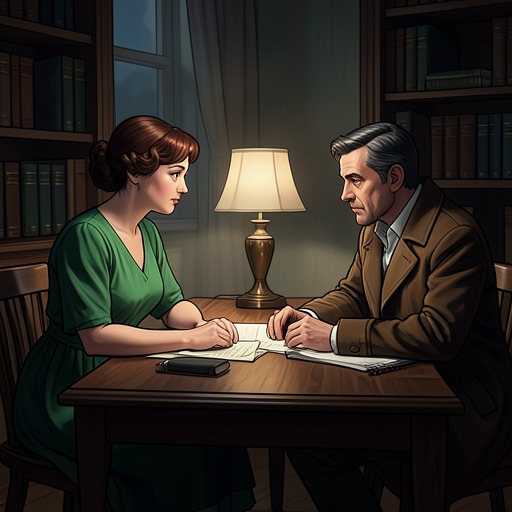
Marilla listens to Anne’s account in silence that bodes ill for Davy, while Mr. Barry laughs and recommends dealing with him summarily. After Mr. Barry leaves, Anne warms and soothes the shivering Dora, gives her supper, and puts her to bed. Only then does Marilla bring Davy in from the stable, where she has found him hiding in its darkest corner, cobwebby and reluctant. Marilla pulls him to the middle of the kitchen; she and Anne sit apart by opposite windows, with the culprit between them. Davy’s subdued posture faces Marilla, but his shamefaced look toward Anne still carries an expectation that they may laugh together later. That expectation makes the breach between them painfully visible.
Remorse, Forgiveness, and Instruction
The search and its exertions have left Anne shaken, and Davy’s apparently unrepentant manner finally brings tears to her eyes. She asks him how he could have done it and whether he understands that it was wrong. Seeing Anne cry changes Davy’s response. He rushes into her lap, throws his arms around her neck, and weeps; his remorse is immediate once he grasps that his conduct has hurt someone he loves.
Davy then explains that he did not know lying was wrong. He has seen Mr. Sprott’s children tell falsehoods regularly, even swearing to them, and says he had been trying hard to be as good as Paul Irving. He fears Anne will no longer love him, apologizes for making her cry, and promises not to lie again. The confession does not undo the deception or Dora’s confinement, but it changes how Anne understands the offense: Davy has acted wrongly, yet he has not understood the moral rule he broke.
Anne tells Marilla that Davy did not know falsehood was wrong and asks that he be forgiven for that part of the offense, provided he promises not to say what is untrue again. Davy makes that promise and offers an extravagant punishment if he breaks it. Anne redirects him from his childish term for a lie to the more precise word falsehood. The exchange turns reprimand into instruction: forgiveness is tied to a clear expectation, and the child is given the language to name the wrongdoing he must avoid.
Significance
The event brings several kinds of fear into the same household scene. Marilla and Anne imagine the worst as they search, especially when Mr. Barry investigates the well; Dora is actually trapped in a small outbuilding, cold and frightened; Davy treats the search as a joke until the consequences of his conduct reach Anne. The sequence moves from uncertainty, through alarm and discovery, to an emotional reversal in the kitchen.
Davy’s change of heart is not prompted by a threat of punishment but by seeing Anne’s tears. That detail connects discipline to the relationship already developing between them: his fear of losing her affection makes his apology sincere, while Anne’s response distinguishes deliberate harm from a child’s ignorance of the rule. The ending does not excuse Davy’s lies; it establishes a promise and a lesson. The disappearance is resolved, but its lasting consequence is a clearer bond between Anne and Davy, founded on affection, truthfulness, and guidance.